Notice:
This site has successfully transitioned the image data source from GOES-16 to
GOES-19. There are some remaining anomalies in the production of mesoscale
geocolor images which are being investigated. Everything else should be operating
as expected. Please contact:
NESDIS.STAR.webmaster@noaa.gov if you have any questions.
12 Jul 2025 - 08:58 EDT
12 Jul 2025 - 12:58 UTC
GOES-West Mesoscale view - Day Cloud Phase / Night Microphysics at 14°S - 170°W - Southern Pacific Ocean
30 frame animation displayed. This mesoscale location is no longer being actively produced.
To enlarge, pause animation & click the image. Hover over popups to zoom. Use slider to navigate.
While GOES animation code will not run on older Internet Explorer browsers,
they work in the newest versions of Microsoft Edge. If you are using
Internet Explorer, please try a different browser: Chrome, Firefox, Safari, or
MS Edge are all supported.
Day Cloud Phase / Night Microphysics - Day: show cloud-top phase; Night: distinguish clouds / fog - 26 Jun 2025 - 0426 UTC
Day Cloud Phase / Night Microphysics - Day: show cloud-top phase; Night: distinguish clouds / fog - 26 Jun 2025 - 0427 UTC
Day Cloud Phase / Night Microphysics - Day: show cloud-top phase; Night: distinguish clouds / fog - 26 Jun 2025 - 0428 UTC
Day Cloud Phase / Night Microphysics - Day: show cloud-top phase; Night: distinguish clouds / fog - 26 Jun 2025 - 0429 UTC
Day Cloud Phase / Night Microphysics - Day: show cloud-top phase; Night: distinguish clouds / fog - 26 Jun 2025 - 0430 UTC
Day Cloud Phase / Night Microphysics - Day: show cloud-top phase; Night: distinguish clouds / fog - 26 Jun 2025 - 0431 UTC
Day Cloud Phase / Night Microphysics - Day: show cloud-top phase; Night: distinguish clouds / fog - 26 Jun 2025 - 0432 UTC
Day Cloud Phase / Night Microphysics - Day: show cloud-top phase; Night: distinguish clouds / fog - 26 Jun 2025 - 0433 UTC
Day Cloud Phase / Night Microphysics - Day: show cloud-top phase; Night: distinguish clouds / fog - 26 Jun 2025 - 0434 UTC
Day Cloud Phase / Night Microphysics - Day: show cloud-top phase; Night: distinguish clouds / fog - 26 Jun 2025 - 0435 UTC
Day Cloud Phase / Night Microphysics - Day: show cloud-top phase; Night: distinguish clouds / fog - 26 Jun 2025 - 0436 UTC
Day Cloud Phase / Night Microphysics - Day: show cloud-top phase; Night: distinguish clouds / fog - 26 Jun 2025 - 0437 UTC
Day Cloud Phase / Night Microphysics - Day: show cloud-top phase; Night: distinguish clouds / fog - 26 Jun 2025 - 0439 UTC
Day Cloud Phase / Night Microphysics - Day: show cloud-top phase; Night: distinguish clouds / fog - 26 Jun 2025 - 0440 UTC
Day Cloud Phase / Night Microphysics - Day: show cloud-top phase; Night: distinguish clouds / fog - 26 Jun 2025 - 0441 UTC
Day Cloud Phase / Night Microphysics - Day: show cloud-top phase; Night: distinguish clouds / fog - 26 Jun 2025 - 0442 UTC
Day Cloud Phase / Night Microphysics - Day: show cloud-top phase; Night: distinguish clouds / fog - 26 Jun 2025 - 0443 UTC
Day Cloud Phase / Night Microphysics - Day: show cloud-top phase; Night: distinguish clouds / fog - 26 Jun 2025 - 0444 UTC
Day Cloud Phase / Night Microphysics - Day: show cloud-top phase; Night: distinguish clouds / fog - 26 Jun 2025 - 0445 UTC
Day Cloud Phase / Night Microphysics - Day: show cloud-top phase; Night: distinguish clouds / fog - 26 Jun 2025 - 0446 UTC
Day Cloud Phase / Night Microphysics - Day: show cloud-top phase; Night: distinguish clouds / fog - 26 Jun 2025 - 0447 UTC
Day Cloud Phase / Night Microphysics - Day: show cloud-top phase; Night: distinguish clouds / fog - 26 Jun 2025 - 0448 UTC
Day Cloud Phase / Night Microphysics - Day: show cloud-top phase; Night: distinguish clouds / fog - 26 Jun 2025 - 0449 UTC
Day Cloud Phase / Night Microphysics - Day: show cloud-top phase; Night: distinguish clouds / fog - 26 Jun 2025 - 0450 UTC
Day Cloud Phase / Night Microphysics - Day: show cloud-top phase; Night: distinguish clouds / fog - 26 Jun 2025 - 0451 UTC
Day Cloud Phase / Night Microphysics - Day: show cloud-top phase; Night: distinguish clouds / fog - 26 Jun 2025 - 0452 UTC
Day Cloud Phase / Night Microphysics - Day: show cloud-top phase; Night: distinguish clouds / fog - 26 Jun 2025 - 0453 UTC
Day Cloud Phase / Night Microphysics - Day: show cloud-top phase; Night: distinguish clouds / fog - 26 Jun 2025 - 0454 UTC
Day Cloud Phase / Night Microphysics - Day: show cloud-top phase; Night: distinguish clouds / fog - 26 Jun 2025 - 0455 UTC
Day Cloud Phase / Night Microphysics - Day: show cloud-top phase; Night: distinguish clouds / fog - 26 Jun 2025 - 0456 UTC
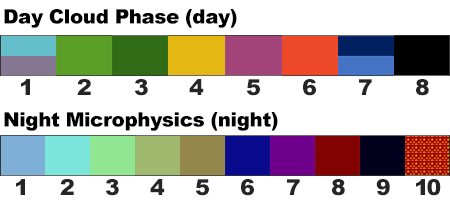
Day Cloud Phase key:
1 - Low level clouds with water droplets (cyan, lavender) 2 - Glaciating clouds (green) 3 - Snow (shades of green) 4 - Thick high level clouds with ice particles (yellow) 5 - Thin mid level clouds with water droplets (magenta) 6 - Thin high-level clouds with ice particles (red-orange) 7 - Land surface (shades of blue) 8 - Water surface (black)
The STAR GOES Imagery Site team has developed the Day Night Cloud Micro Combo product to more efficiently deliver the observational value of both the Day Cloud Phase Distinction & Night Microphysics RGB products.
Daytime: Day Cloud Phase RGB The daytime period of this RGB helps evaluate the phase of cooling cloud tops to monitor convective initiation, storm growth, and decay. It can also be used to identify snow on the ground. The Day Cloud Phase Distinction RGB takes advantage of cloud reflectance differences between the visible and near infrared channels and temperature variances between land and clouds in the infrared to provide increased contrast between background surfaces and phases of clouds (i.e., water vs. ice). Due to its reliance on visible bands 2 and 5, it is only usable during daylight hours. This composite was developed by the Japan Meteorological Agency (JMA) for Himawari-8. Interpretation is still under investigation.
Nighttime: Nighttime Microphysics RGB The distinction between low clouds and fog in satellite imagery is challenging. While the difference between the 10.4 and 3.9 μm channels has been a regularly applied product to meet aviation forecast needs, the Nighttime Microphysics (NtMicro) RGB adds another channel difference (12.4- 10.4 μm) as a proxy to cloud thickness and repeats the use of the 10.4 μm thermal channel to enhance areas of warm (i.e., low) clouds where fog is more likely. The NtMicro RGB is also an efficient tool to quickly identify other cloud types in the mid and upper atmosphere.